
Difference between revisions of "Luzula comosa var. laxa"
| (21 intermediate revisions by 4 users not shown) | |||
| Line 1: | Line 1: | ||
| − | [[File: | + | * Scientific Name: ''Luzula comosa'' var. ''laxa'' |
| + | * Family: Juncaceae | ||
| + | * Common Names: Pacific woodrush | ||
| + | * Synonyms/Misapplications: ''Luzula intermedia, Luzula multiflora'' subsp. ''comosa'' | ||
| + | * Codon: LUZCOM | ||
| + | ---- | ||
| + | [[File:LUZCOM1.jpg |thumb|Photo by Robert L. Carr, also featured on Main Page]] | ||
| + | === Taxonomy === | ||
| + | {{Taxobox | ||
| + | | image = | ||
| + | | image_caption = Photo by Robert L. Carr. Also featured on Main Page. | ||
| + | | name = ''Luzula comosa'' var. ''laxa'' | ||
| + | | regnum = [[Plant]]ae | ||
| + | | subregnum = Viridiplantae | ||
| + | | phylum = Tracheophyta | ||
| + | | subphylum= Spermatophytina | ||
| + | | classis = Magnoliopsida | ||
| + | | subclassis = Lilianae | ||
| + | | ordo = Poales | ||
| + | | familia = Juncaceae | ||
| + | | genus = ''Luzula'' DC. | ||
| + | | species = ''''' Luzula comosa''''' E. Mey | ||
| + | | subspecies = '''''Luzula comosa'' var. ''laxa''''' Buchenau (not accepted) | ||
| + | | synonyms = *''Luzula intermedia'' (Thuill.) A. Nelson | ||
| + | *''Luzula multiflora'' ssp. ''comosa'' (E. Mey.) Hultén | ||
| + | *''Luzula comosa'' var. ''congesta'' (Thuill.) S. Watson | ||
| + | *''Luzula multiflora'' var. ''comosa'' (E. Mey.) H. St. John | ||
| + | }} | ||
| + | <ref>Integrated Taxonomic Information System. Retrieved from https://www.itis.gov/servlet/SingleRpt/SingleRpt?search_topic=TSN&search_value=39339#null</ref> | ||
| + | ===Description=== | ||
| + | Native tufted perennial, reaching 1-4 dm in height. | ||
| + | Leaves are grass-like, reddish to green, with long, fine hairs along leaf margin. | ||
| + | Inflorescence consists of 1 to 6 brownish glomerules (a condensed, headlike, cluster of flowers). The individual flowers consist of 6 membranous pallid, brownish tepals. ''Luzula comosa'' var. ''laxa'' generally has a more open, subumbellate inflorescence than ''Luzula comosa'' var. ''comosa'', which has a tighter capitate inflorescence. | ||
| + | Juncaceae family members are differentiated from grasses in that they typically feature round stems, without nodes. <ref name=":0">Bowcutt, F., & Hamman, Sarah. (2016). ''Vascular plants'' | ||
| + | of the South Sound prairies'' (First ed.). Olympia, Washington: The Evergreen'' | ||
| + | State College Press.</ref><ref name=":1">Hitchcock, C. L., Cronquist, A., Giblin, D., & Legler, | ||
| + | B. et al. (2018). ''Flora of the Pacific Northwest: an illustrated manual''. | ||
| + | Seattle: University of Washington Press.</ref> | ||
| + | ===Bloom Period=== | ||
| + | April to July<ref name=":0" /> | ||
| + | ===Distribution=== | ||
| + | BC to California, along both sides of Cascades, east to Alberta, Montana, Utah, and New Mexico.<ref name=":1" /> | ||
| + | ===Habitat=== | ||
| + | Openings, rocky slopes, forest, and shores, coastal to montane.<ref name=":1" /> | ||
| − | + | === Seed === | |
| − | + | Seed sample from:''' 2008''' | |
| − | + | ||
| − | + | ||
| − | + | ||
| − | + | ||
| − | + | ||
| − | + | ||
| − | + | ||
| − | + | ||
| − | + | ||
| − | + | ||
| − | + | ||
| − | + | ||
| − | + | ||
| − | + | ||
| − | ===Seed=== | + | |
| − | + | ||
'''Average Measurement:''' 1.5 x 0.9 x 0.9 | '''Average Measurement:''' 1.5 x 0.9 x 0.9 | ||
| Line 31: | Line 58: | ||
'''Measurement Range:''' L: 1.2 – 1.8, W: 0.8 – 1, D:0.8 – 1 | '''Measurement Range:''' L: 1.2 – 1.8, W: 0.8 – 1, D:0.8 – 1 | ||
| − | + | '''Features''' | |
'''Shape:''' Seeds have prominent white caruncle. Seed mostly round except for a slightly pointed tapering at hilum and opposite apex. | '''Shape:''' Seeds have prominent white caruncle. Seed mostly round except for a slightly pointed tapering at hilum and opposite apex. | ||
| Line 43: | Line 70: | ||
'''Longitudinal Cross Section:''' elliptical [[File:Luzula long.png]] | '''Longitudinal Cross Section:''' elliptical [[File:Luzula long.png]] | ||
| + | === Photo Gallery === | ||
| + | <gallery> | ||
| + | File:LUZCOM2.jpg| Photo by Robert L. Carr | ||
| + | </gallery> | ||
| + | ===References=== | ||
| − | + | ||
| − | + | ||
| − | + | <references /> | |
| − | + | ||
| − | </ | + | |
Latest revision as of 21:43, 20 March 2021
- Scientific Name: Luzula comosa var. laxa
- Family: Juncaceae
- Common Names: Pacific woodrush
- Synonyms/Misapplications: Luzula intermedia, Luzula multiflora subsp. comosa
- Codon: LUZCOM

Contents
Taxonomy
| Luzula comosa var. laxa | |
|---|---|
| Scientific classification | |
| Kingdom: | Plantae |
| Subkingdom: | Viridiplantae |
| Phylum: | Tracheophyta |
| Subphylum: | Spermatophytina |
| Class: | Magnoliopsida |
| Subclass: | Lilianae |
| Order: | Poales |
| Family: | Juncaceae |
| Genus: | Luzula DC. |
| Species: | Luzula comosa E. Mey |
| Subspecies: | Luzula comosa var. laxa Buchenau (not accepted) |
| Synonyms | |
| |
Description
Native tufted perennial, reaching 1-4 dm in height.
Leaves are grass-like, reddish to green, with long, fine hairs along leaf margin.
Inflorescence consists of 1 to 6 brownish glomerules (a condensed, headlike, cluster of flowers). The individual flowers consist of 6 membranous pallid, brownish tepals. Luzula comosa var. laxa generally has a more open, subumbellate inflorescence than Luzula comosa var. comosa, which has a tighter capitate inflorescence.
Juncaceae family members are differentiated from grasses in that they typically feature round stems, without nodes. [2][3]
Bloom Period
April to July[2]
Distribution
BC to California, along both sides of Cascades, east to Alberta, Montana, Utah, and New Mexico.[3]
Habitat
Openings, rocky slopes, forest, and shores, coastal to montane.[3]
Seed
Seed sample from: 2008
Average Measurement: 1.5 x 0.9 x 0.9
Measurement Range: L: 1.2 – 1.8, W: 0.8 – 1, D:0.8 – 1
Features
Shape: Seeds have prominent white caruncle. Seed mostly round except for a slightly pointed tapering at hilum and opposite apex.
Color: Seed coat is white over a dark reddish brown seed body.
Surface: On one side of seed there is a cloudy white line that crosses from hilum to opposite apex. Seed is lustrous and marked with many fine longitudinal lines.
Latitudinal Cross Section: elliptical 
Longitudinal Cross Section: elliptical 
Photo Gallery
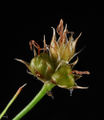
Photo by Robert L. Carr

References
- ↑ Integrated Taxonomic Information System. Retrieved from https://www.itis.gov/servlet/SingleRpt/SingleRpt?search_topic=TSN&search_value=39339#null
- ↑ 2.0 2.1 Bowcutt, F., & Hamman, Sarah. (2016). Vascular plants of the South Sound prairies (First ed.). Olympia, Washington: The Evergreen State College Press.
- ↑ 3.0 3.1 3.2 Hitchcock, C. L., Cronquist, A., Giblin, D., & Legler, B. et al. (2018). Flora of the Pacific Northwest: an illustrated manual. Seattle: University of Washington Press.
