
Difference between revisions of "Triteleia hyacinthina"
(Created page with '==Taxonomy== ==Description== ==Bloom Period== ==Distribution== ==Habitat== ==Uses== ==Propagation== ==Photo Gallery== ==References==') |
(→Habitat) (Tag: VisualEditor) |
||
| (12 intermediate revisions by 2 users not shown) | |||
| Line 1: | Line 1: | ||
| − | ==Taxonomy== | + | * Scientific Name: ''Tritelia hyacinthina'' (Lindl.) Greene |
| − | ==Description== | + | * Family: Asparagaceae. |
| − | ==Bloom Period== | + | * Common Names: fools' onion, hyacinth brodiaea, hyacinth triplet-lily, white brodiaea |
| − | ==Distribution== | + | * Synonyms/Misapplications: ''Brodiaea hyacinthina'' |
| − | ==Habitat== | + | * Codon: TRIHYA |
| − | == | + | ---- |
| − | == | + | [[File:TRIHYA3.jpg|thumb|Photo: Ben Legler 2004, also featured on Main Page]] |
| − | ==Photo Gallery== | + | ===Taxonomy=== |
| − | ==References== | + | {{Taxobox |
| + | | name = | ||
| + | | regnum = [[Plant]]ae | ||
| + | | subregnum = Viridiplantae | ||
| + | | phylum = Tracheophyta | ||
| + | | subphylum= Spermatophytina | ||
| + | | classis = Magnoliopsida | ||
| + | | subclassis = Lilianae | ||
| + | | ordo = Asparagales | ||
| + | | familia = Asparagaceae | ||
| + | | genus = ''Triteleia'' Lindl. | ||
| + | | species = '''''Triteleia hyacinthina''''' (Lindl.) Greene | ||
| + | | binomial authority = | ||
| + | }} | ||
| + | <ref>Integrated Taxonomic Information System. Retrieved from https://www.itis.gov/servlet/SingleRpt/SingleRpt?search_topic=TSN&search_value=43098#null</ref> | ||
| + | |||
| + | ===Description=== | ||
| + | Scapose herbs growing from fibrous corms. 6 tepals alike. Flowers few to many in an open, bracteate umbel, perianth 6-16mm, connate up to half the length. white or tinged with blue, the tube shallowly bowl-shaped, lobes with a narrow green midvein. Stamens 6, anthers pale yellow, rarely blue, filaments triangular, confluent at their bases. Leaves 1-2, flat | ||
| + | but keeled beneath, 3-10 mm broad and up to 4 dm long, not withered by | ||
| + | flowering. Fruit is a three-celled capsule, with a stype nearly as long. <ref name=":0">Hitchcock, C. L., Cronquist, A., Giblin, D., | ||
| + | & Legler, B. et al. (2018). ''Flora of the Pacific Northwest: an'' | ||
| + | illustrated manual''. Seattle: University of Washington Press''</ref><ref name=":1">WTU Herbarium, Burke Museum, | ||
| + | & University of Washington. (n.d.). Retrieved from <nowiki>https://biology.burke.washington.edu/herbarium/imagecollection/taxon.php?Taxon=Triteleia%20hyacinthina</nowiki></ref> | ||
| + | |||
| + | ===Bloom Period=== | ||
| + | May-August<ref name=":1" /> | ||
| + | |||
| + | ===Distribution=== | ||
| + | Southwest BC to coastal California, from coast inland to Idaho and eastern Oregon.<ref name=":0" /> | ||
| + | |||
| + | ===Habitat=== | ||
| + | Sagebrush steppe and grassy, open, and often rocky areas from low to mid-elevations.<ref name=":1" /> | ||
| + | |||
| + | ===Uses=== | ||
| + | Food and Medicine: Ethnobotanical records of Pomo peoples and other nations eating the corms baked or boiled.<ref>Native American Ethnobotany Database. (n.d.). Retrieved from <nowiki>http://naeb.brit.org/uses/search/?string=triteleia</nowiki></ref> | ||
| + | |||
| + | ===Photo Gallery=== | ||
| + | <gallery> | ||
| + | File:TRIHYA4.jpg| 2004 Ben Legler | ||
| + | File:TRIHYA2.jpg| 2004 Ben Legler | ||
| + | </gallery> | ||
| + | |||
| + | ===References=== | ||
| + | <references /> | ||
Latest revision as of 13:14, 30 June 2021
- Scientific Name: Tritelia hyacinthina (Lindl.) Greene
- Family: Asparagaceae.
- Common Names: fools' onion, hyacinth brodiaea, hyacinth triplet-lily, white brodiaea
- Synonyms/Misapplications: Brodiaea hyacinthina
- Codon: TRIHYA

Contents
Taxonomy
| Scientific classification | |
|---|---|
| Kingdom: | Plantae |
| Subkingdom: | Viridiplantae |
| Phylum: | Tracheophyta |
| Subphylum: | Spermatophytina |
| Class: | Magnoliopsida |
| Subclass: | Lilianae |
| Order: | Asparagales |
| Family: | Asparagaceae |
| Genus: | Triteleia Lindl. |
| Species: | Triteleia hyacinthina (Lindl.) Greene |
Description
Scapose herbs growing from fibrous corms. 6 tepals alike. Flowers few to many in an open, bracteate umbel, perianth 6-16mm, connate up to half the length. white or tinged with blue, the tube shallowly bowl-shaped, lobes with a narrow green midvein. Stamens 6, anthers pale yellow, rarely blue, filaments triangular, confluent at their bases. Leaves 1-2, flat but keeled beneath, 3-10 mm broad and up to 4 dm long, not withered by flowering. Fruit is a three-celled capsule, with a stype nearly as long. [2][3]
Bloom Period
May-August[3]
Distribution
Southwest BC to coastal California, from coast inland to Idaho and eastern Oregon.[2]
Habitat
Sagebrush steppe and grassy, open, and often rocky areas from low to mid-elevations.[3]
Uses
Food and Medicine: Ethnobotanical records of Pomo peoples and other nations eating the corms baked or boiled.[4]
Photo Gallery
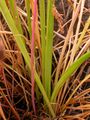
2004 Ben Legler
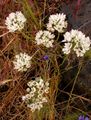
2004 Ben Legler


References
- ↑ Integrated Taxonomic Information System. Retrieved from https://www.itis.gov/servlet/SingleRpt/SingleRpt?search_topic=TSN&search_value=43098#null
- ↑ 2.0 2.1 Hitchcock, C. L., Cronquist, A., Giblin, D., & Legler, B. et al. (2018). Flora of the Pacific Northwest: an illustrated manual. Seattle: University of Washington Press
- ↑ 3.0 3.1 3.2 WTU Herbarium, Burke Museum, & University of Washington. (n.d.). Retrieved from https://biology.burke.washington.edu/herbarium/imagecollection/taxon.php?Taxon=Triteleia%20hyacinthina
- ↑ Native American Ethnobotany Database. (n.d.). Retrieved from http://naeb.brit.org/uses/search/?string=triteleia
