
Difference between revisions of "Solidago missouriensis"
(→References) |
(→Taxnomy) |
||
| (27 intermediate revisions by 4 users not shown) | |||
| Line 1: | Line 1: | ||
| − | ==Taxonomy== | + | * Scientific Name: ''Solidago missouriensis'' |
| − | + | * Family: Asteraceae | |
| − | + | * Common Name: Missouri goldenrod | |
| − | + | * Codon: SOLMIS | |
| − | + | ---- | |
| − | + | [[File:SOLMIS1.jpg |thumb|Photo by Richard Old, also featured on Main Page]] | |
| − | + | ===Taxonomy=== | |
| − | + | {{Taxobox | |
| − | + | | name = | |
| − | + | | image = | |
| − | + | | image_caption = Photo by Richard Old, also featured on Main Page | |
| − | <ref> | + | | regnum = [[Plant]]ae |
| + | | subregnum = Viridiplantae | ||
| + | | phylum = Tracheophyta | ||
| + | | subphylum= Spermatophytina | ||
| + | | classis = Magnoliopsida | ||
| + | | subclassis = Asteranae | ||
| + | | ordo = Asterales | ||
| + | | familia = Asteraceae | ||
| + | | genus = ''Solidago'' L. | ||
| + | | species = '''''Solidago missouriensis''''' Nutt. | ||
| + | | subspecies = | ||
| + | | synonyms = *''Solidago glaberrima'' M. Martens | ||
| + | *''Solidago tenuissima'' Woot. & Standl. | ||
| + | }} | ||
| + | <ref>Integrated Taxonomic Information System. Retrieved from https://www.itis.gov/servlet/SingleRpt/SingleRpt?search_topic=TSN&search_value=36277#null</ref> | ||
| − | ==Description== | + | ===Description=== |
| − | + | Glabrous perennial from a creeping rhizome, 2-9 dm. tall. | |
| − | + | Leaves tending to be triple-nerved, the basal ones oblanceolate, up to 30 cm. long and 3 cm. wide, the others smaller and becoming sessile upward. | |
| − | Flowers | + | Flowers arranged in long narrow panicles. Involucre 3-5 mm. high, pseudanthium made up of 7-13 ray florets and 8-13 disk florets, yellow.<ref name=":0">WTU Herbarium, Burke Museum, |
| + | & University of Washington. Retrieved from <nowiki>https://biology.burke.washington.edu/herbarium/imagecollection/taxon.php?Taxon=Solidago%20missouriensis</nowiki></ref><ref>Bowcutt, F., & Hamman, Sarah. (2016). ''Vascular plants of the South Sound prairies'' (First ed.). Olympia, Washington: The Evergreen State College Press.</ref> | ||
| − | ==Bloom Period== | + | ===Bloom Period=== |
| − | = | + | Late June-October<ref name=":0" /> |
| − | + | ||
| − | ==Habitat== | + | ===Distribution=== |
| − | ==Uses== | + | East Cascades, and rarely on prairies on west Cascades, central BC to Oregon, east to Rocky Mountains, Great Plains, and Midwest.<ref name=":1">Hitchcock, |
| − | ==Propagation== | + | C. L., Cronquist, A., Giblin, D., & Legler, B. et al. (2018). ''Flora of'' |
| − | ==Photo Gallery== | + | the Pacific Northwest: an illustrated manual''. Seattle: University of'' |
| − | ==References== | + | Washington Press.</ref> |
| − | <references/> | + | |
| + | ===Habitat=== | ||
| + | Rather dry, open places, from the valleys and plains to fairly high elevations in the mountains.<ref name=":1" /> | ||
| + | |||
| + | === Uses === | ||
| + | Gregory L. Tilford writes that the species within the ''Solidago'' genus may be used more or less interchangeably. He writes the greens can be eaten a cooked potherb, with variable palatibility, and the flowers make a nice sweetened tea. Dried leaves and flowers may be used as a styptic agent, and an infusion to reduce mucus production in the bronchi during a cold or flu. The tea is diuretic and regarded by him as a kidney tonic.<ref>Tilford, G. L. (1999). ''Edible and medicinal plants of the | ||
| + | west''. Missoula, MT: Mountain Press Pub. Co.</ref> | ||
| + | |||
| + | ===Propagation=== | ||
| + | Plants established by seedlings can be started by sowing seed in containers in January and placed in a greenhouse. Seed should be covered lightly with soil and kept moist until germination. A layer of pea gravel can be applied to the soil surface to prevent seeds from floating. Seeds planted in this manner | ||
| + | will begin germination about Day 7 and complete germination by Day 14. | ||
| + | <ref>Skinner, D. 2004. Propagation protocol for production of container Solidago missouriensis Nutt. Plants; USDA NRCS Plant Materials Center, Pullman, WA. </ref> | ||
| + | |||
| + | ===Photo Gallery=== | ||
| + | <gallery> | ||
| + | SOLMIS8.jpg| Photo by Ron Bockelman, 2011 | ||
| + | SOLMIS9.jpg| Photo by Ron Bockelman, 2011 | ||
| + | SOLMLIS7.jpg| Photo by Richard Old, | ||
| + | SOLMIS2.jpg| Photo CNLM | ||
| + | SOLMIS5.png| Photo CNLM | ||
| + | SOLMIS3.jpg| Solidago seedling, courtesy CNLM | ||
| + | </gallery> | ||
| + | |||
| + | ===References=== | ||
| + | <references /> | ||
Latest revision as of 22:57, 20 March 2021
- Scientific Name: Solidago missouriensis
- Family: Asteraceae
- Common Name: Missouri goldenrod
- Codon: SOLMIS

Contents
Taxonomy
| Scientific classification | |
|---|---|
| Kingdom: | Plantae |
| Subkingdom: | Viridiplantae |
| Phylum: | Tracheophyta |
| Subphylum: | Spermatophytina |
| Class: | Magnoliopsida |
| Subclass: | Asteranae |
| Order: | Asterales |
| Family: | Asteraceae |
| Genus: | Solidago L. |
| Species: | Solidago missouriensis Nutt. |
| Synonyms | |
| |
Description
Glabrous perennial from a creeping rhizome, 2-9 dm. tall.
Leaves tending to be triple-nerved, the basal ones oblanceolate, up to 30 cm. long and 3 cm. wide, the others smaller and becoming sessile upward.
Flowers arranged in long narrow panicles. Involucre 3-5 mm. high, pseudanthium made up of 7-13 ray florets and 8-13 disk florets, yellow.[2][3]
Bloom Period
Late June-October[2]
Distribution
East Cascades, and rarely on prairies on west Cascades, central BC to Oregon, east to Rocky Mountains, Great Plains, and Midwest.[4]
Habitat
Rather dry, open places, from the valleys and plains to fairly high elevations in the mountains.[4]
Uses
Gregory L. Tilford writes that the species within the Solidago genus may be used more or less interchangeably. He writes the greens can be eaten a cooked potherb, with variable palatibility, and the flowers make a nice sweetened tea. Dried leaves and flowers may be used as a styptic agent, and an infusion to reduce mucus production in the bronchi during a cold or flu. The tea is diuretic and regarded by him as a kidney tonic.[5]
Propagation
Plants established by seedlings can be started by sowing seed in containers in January and placed in a greenhouse. Seed should be covered lightly with soil and kept moist until germination. A layer of pea gravel can be applied to the soil surface to prevent seeds from floating. Seeds planted in this manner will begin germination about Day 7 and complete germination by Day 14. [6]
Photo Gallery
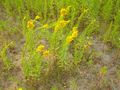
Photo by Ron Bockelman, 2011
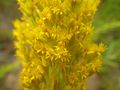
Photo by Ron Bockelman, 2011
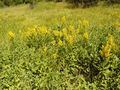
Photo by Richard Old,
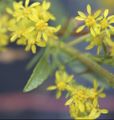
Photo CNLM
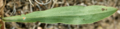
Photo CNLM
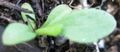
Solidago seedling, courtesy CNLM


References
- ↑ Integrated Taxonomic Information System. Retrieved from https://www.itis.gov/servlet/SingleRpt/SingleRpt?search_topic=TSN&search_value=36277#null
- ↑ 2.0 2.1 WTU Herbarium, Burke Museum, & University of Washington. Retrieved from https://biology.burke.washington.edu/herbarium/imagecollection/taxon.php?Taxon=Solidago%20missouriensis
- ↑ Bowcutt, F., & Hamman, Sarah. (2016). Vascular plants of the South Sound prairies (First ed.). Olympia, Washington: The Evergreen State College Press.
- ↑ 4.0 4.1 Hitchcock, C. L., Cronquist, A., Giblin, D., & Legler, B. et al. (2018). Flora of the Pacific Northwest: an illustrated manual. Seattle: University of Washington Press.
- ↑ Tilford, G. L. (1999). Edible and medicinal plants of the west. Missoula, MT: Mountain Press Pub. Co.
- ↑ Skinner, D. 2004. Propagation protocol for production of container Solidago missouriensis Nutt. Plants; USDA NRCS Plant Materials Center, Pullman, WA.
