
Difference between revisions of "Potentilla gracilis var. gracilis"
m (Haysar24 moved page Potentilla gracilis to Potentilla gracilis var. gracilis without leaving a redirect) |
|||
| (3 intermediate revisions by 2 users not shown) | |||
| Line 1: | Line 1: | ||
| − | '''Common names''' | + | *Scientific Name: ''Potentilla gracilis'' var. ''gracilis'' |
| + | *Family: ''Rosaceae'' | ||
| + | *Common names: slender cinquefoil, graceful cinquefoil | ||
| + | *Synonyms/Misapplications: ''Potentilla gracilis'' vars. ''fastigiata, glabrata, permollis, Potentilla fastigiata, P. glomerata, P. macropetala, P. longipedunculata'' | ||
| + | *Codon: POTGRA | ||
| + | ---- | ||
| + | [[File:POGR BenLegler flw avg.jpg|thumb|Photo by Ben Legler, also featured on Main Page]] | ||
| − | ''' | + | ===Taxonomy=== |
| + | {{Taxobox | ||
| + | | name = | ||
| + | | regnum = [[Plant]]ae | ||
| + | | subregnum = Viridiplantae | ||
| + | | phylum = Tracheophyta | ||
| + | | subphylum= Spermatophytina | ||
| + | | classis = Magnoliopsida | ||
| + | | subclassis = Rosanae | ||
| + | | ordo = Rosales | ||
| + | | familia = Rosaceae | ||
| + | | genus = ''Potentilla'' L. | ||
| + | | species = '''''Potentilla gracilis''''' Douglas ex Hook. | ||
| + | | subspecies = '''''Potentilla gracilis'' var. ''gracilis''''' Douglas ex Hook. | ||
| + | | synonyms = *''Potentilla macropetala'' Rydb. | ||
| + | *''Potentilla longipedunculata'' Rydb. | ||
| + | }} | ||
| + | <ref>Integrated Taxonomic Information System. Retrieved from https://www.itis.gov/servlet/SingleRpt/SingleRpt?search_topic=TSN&search_value=24715#null</ref> | ||
| − | == | + | ===Description=== |
| − | + | Highly variable native perennial from rising from a branched crown, erect to slightly spreading stems, 4-8 dm tall. 5 varieties are intergrading. | |
| − | + | ||
| − | + | ||
| − | + | ||
| − | + | ||
| − | + | ||
| − | + | ||
| − | + | ||
| − | + | Basal leaves are numerous, the leaves are white woolly on the underside, bear large stipules, comprised of 5-9 leaflets, oblong-eliptic, margins deeply toothed. | |
| − | + | ||
| − | + | Inflorescence large, many-flowered, open, somewhat flat-topped; calyx 6-10 mm. broad, the 5 lobes 4-10 mm. long, ovate-lanceolate, the alternating bracteoles narrowly lanceolate, nearly as long; petals 5, yellow, obcordate, longer than the sepals; stamens 20; pistils numerous, the style slender, sub-terminal on the achene and the same length. | |
| − | + | Fruit is an achene 1.5-2 mm. long, smooth, greenish.<ref>Klinkenberg, Brian. (Editor) 2020. ''E-Flora BC: Electronic Atlas of the Plants of British Columbia'' [eflora.bc.ca]. Lab for Advanced Spatial Analysis, Department of Geography, University of British Columbia, Vancouver. [Accessed:2020-05-09]</ref><ref name=":0">Bowcutt, F., & Hamman, Sarah. (2016). ''Vascular plants | |
| + | of the South Sound prairies'' (First ed.). Olympia, Washington: The Evergreen | ||
| + | State College Press.</ref> | ||
| − | + | ===Bloom Period=== | |
| + | July - August.<ref name=":0" /> | ||
| − | == | + | ===Distribution=== |
| − | + | Alaska south, on both sides of Cascades, to California, east to Quebec, Montana, Colorado and Arizona.<ref name=":1">MacKinnon, A., Pojar, Jim, & Alaback, Paul B. (2004). ''Plants | |
| + | of the Pacific Northwest coast : Washington, Oregon, British Columbia & | ||
| + | Alaska'' (Rev. ed.). Vancouver: Lone Pine Pub.</ref> | ||
| − | == | + | ===Habitat=== |
| − | + | Damp to seasonally damp meadows, flatlands, sagebrush steppes, open forest.<ref name=":1" /> | |
| − | + | ===Uses=== | |
| − | + | ||
| − | + | ||
| − | + | ||
| − | + | ||
| − | ==Uses== | + | |
Wildlife: Medium palatability for browsing and grazing animals. | Wildlife: Medium palatability for browsing and grazing animals. | ||
| − | First Nations: | + | First Nations: Sx̌ʷyʔiɬpx use, infusion of pounded root as a blood tonic, antidiarrheal, and general tonic for aches and wash for sores. Nlaka'pamux use as root and leaf poultice, mixed with subalpine fir pitch, used as a drawing medicine on wounds.<ref>Native American Ethnobotany Database. Retrieved from <nowiki>http://naeb.brit.org/uses/search/?string=potentilla+gracilis</nowiki></ref> |
| − | ==Propagation== | + | ===Propagation=== |
| − | ==Photo Gallery== | + | ===Photo Gallery=== |
| − | < | + | <gallery> |
| − | File: | + | File:POTGRA2.jpg|photo by Ben Legler |
| − | File:POGR LisaHintz sd 2012.jpg | + | File:POTGRA3.jpg|photo by Ben Legler |
| − | </ | + | File:POTGRA4.jpg|young growth, courtesy of CNLM |
| − | ==References== | + | File:POTGRA5.jpg|seedling, courtesy of CNLM |
| + | File:POGR LisaHintz sd 2012.jpg|seeds, photo by Lisa Hintz | ||
| + | </gallery> | ||
| + | ===References=== | ||
Latest revision as of 22:30, 20 March 2021
- Scientific Name: Potentilla gracilis var. gracilis
- Family: Rosaceae
- Common names: slender cinquefoil, graceful cinquefoil
- Synonyms/Misapplications: Potentilla gracilis vars. fastigiata, glabrata, permollis, Potentilla fastigiata, P. glomerata, P. macropetala, P. longipedunculata
- Codon: POTGRA

Contents
Taxonomy
| Scientific classification | |
|---|---|
| Kingdom: | Plantae |
| Subkingdom: | Viridiplantae |
| Phylum: | Tracheophyta |
| Subphylum: | Spermatophytina |
| Class: | Magnoliopsida |
| Subclass: | Rosanae |
| Order: | Rosales |
| Family: | Rosaceae |
| Genus: | Potentilla L. |
| Species: | Potentilla gracilis Douglas ex Hook. |
| Subspecies: | Potentilla gracilis var. gracilis Douglas ex Hook. |
| Synonyms | |
| |
Description
Highly variable native perennial from rising from a branched crown, erect to slightly spreading stems, 4-8 dm tall. 5 varieties are intergrading.
Basal leaves are numerous, the leaves are white woolly on the underside, bear large stipules, comprised of 5-9 leaflets, oblong-eliptic, margins deeply toothed.
Inflorescence large, many-flowered, open, somewhat flat-topped; calyx 6-10 mm. broad, the 5 lobes 4-10 mm. long, ovate-lanceolate, the alternating bracteoles narrowly lanceolate, nearly as long; petals 5, yellow, obcordate, longer than the sepals; stamens 20; pistils numerous, the style slender, sub-terminal on the achene and the same length.
Fruit is an achene 1.5-2 mm. long, smooth, greenish.[2][3]
Bloom Period
July - August.[3]
Distribution
Alaska south, on both sides of Cascades, to California, east to Quebec, Montana, Colorado and Arizona.[4]
Habitat
Damp to seasonally damp meadows, flatlands, sagebrush steppes, open forest.[4]
Uses
Wildlife: Medium palatability for browsing and grazing animals.
First Nations: Sx̌ʷyʔiɬpx use, infusion of pounded root as a blood tonic, antidiarrheal, and general tonic for aches and wash for sores. Nlaka'pamux use as root and leaf poultice, mixed with subalpine fir pitch, used as a drawing medicine on wounds.[5]
Propagation
Photo Gallery
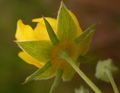
photo by Ben Legler
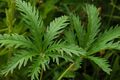
photo by Ben Legler
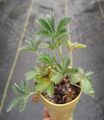
young growth, courtesy of CNLM
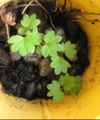
seedling, courtesy of CNLM
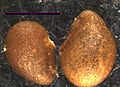
seeds, photo by Lisa Hintz


References
- ↑ Integrated Taxonomic Information System. Retrieved from https://www.itis.gov/servlet/SingleRpt/SingleRpt?search_topic=TSN&search_value=24715#null
- ↑ Klinkenberg, Brian. (Editor) 2020. E-Flora BC: Electronic Atlas of the Plants of British Columbia [eflora.bc.ca]. Lab for Advanced Spatial Analysis, Department of Geography, University of British Columbia, Vancouver. [Accessed:2020-05-09]
- ↑ 3.0 3.1 Bowcutt, F., & Hamman, Sarah. (2016). Vascular plants of the South Sound prairies (First ed.). Olympia, Washington: The Evergreen State College Press.
- ↑ 4.0 4.1 MacKinnon, A., Pojar, Jim, & Alaback, Paul B. (2004). Plants of the Pacific Northwest coast : Washington, Oregon, British Columbia & Alaska (Rev. ed.). Vancouver: Lone Pine Pub.
- ↑ Native American Ethnobotany Database. Retrieved from http://naeb.brit.org/uses/search/?string=potentilla+gracilis
