
Difference between revisions of "Koeleria macrantha"
m (Tag: VisualEditor) |
|||
| (5 intermediate revisions by 2 users not shown) | |||
| Line 1: | Line 1: | ||
| − | * | + | * Scientific Name: ''Koeleria'' ''macrantha'' |
* Family: Poaceae | * Family: Poaceae | ||
* Common Names: Koeler's prairie grass, prairie junegrass | * Common Names: Koeler's prairie grass, prairie junegrass | ||
* Synonyms/Misapplications: ''Koeleria'' ''cristata, Koeleria'' ''gracilis, Koeleria'' ''nitida, Koeleria'' ''yukonensis'' | * Synonyms/Misapplications: ''Koeleria'' ''cristata, Koeleria'' ''gracilis, Koeleria'' ''nitida, Koeleria'' ''yukonensis'' | ||
* Codon: KOEMAC | * Codon: KOEMAC | ||
| − | ==Taxonomy== | + | ---- |
| + | [[File:KOEMAC1.jpg |thumb|Photo by Craig Althen, 2015, also featured on Main Page]] | ||
| + | ===Taxonomy=== | ||
| + | {{Taxobox | ||
| + | | name = | ||
| + | | image = | ||
| + | | image_alt = Koeleria macrantha | ||
| + | | image_caption = Photo by Craig Althen, 2015. Featured on Main Page | ||
| + | | regnum = [[Plant]]ae | ||
| + | | subregnum = Viridiplantae | ||
| + | | phylum = Tracheophyta | ||
| + | | subphylum= Spermatophytina | ||
| + | | classis = Magnoliopsida | ||
| + | | subclassis = Lilianae | ||
| + | | ordo = Poales | ||
| + | | familia = Poaceae | ||
| + | | genus = ''Koeleria'' Pers. | ||
| + | | species = '''''Koeleria macrantha''''' (Ledeb.) Schult. | ||
| + | | binomial = | ||
| + | | binomial_authority = | ||
| + | | synonyms = *''Koeleria nitida'' Nutt. | ||
| + | *''Koeleria gracilis'' Pers. | ||
| + | *''Koeleria yukonensis'' Hultén | ||
| + | *''Koeleria cristata'' var. ''longifolia'' Vasey ex Burtt Davy | ||
| + | *''Koeleria cristata ''var. ''pinetorum'' Abrams | ||
| + | *''Koeleria idahoensis'' Domin | ||
| + | | range_map = | ||
| + | | range_map_alt = | ||
| + | | range_map_caption = | ||
| + | }} | ||
| + | <ref>Integrated Taxonomic Information System. Retrieved from https://www.itis.gov/servlet/SingleRpt/SingleRpt?search_topic=TSN&search_value=503284</ref> | ||
| − | ==Description== | + | ===Description=== |
| − | + | Native, perennial, cool season bunchgrass.<ref name=":0">Ogle, | |
| + | Daniel G. 2012. Plant fact sheet for prairie junegrass (Koeleria macrantha). | ||
| + | USDA-Natural Resources Conservation Service, Boise, ID</ref> | ||
| − | + | Leaf sheaths are open, leaves are 1-2mm broad, and basally tufted. | |
| − | The | + | Culms are 3-6 dm tall, topped with fluffy-appearing, congested inflorescences (4-13cm.) which form a spike-like panicle. |
| − | ==Bloom Period== | + | |
| − | May - June | + | The spikelets are mostly 2-flowered and are borne on short pedicels with paleas shorter than the lemmas<ref name=":1">Bowcutt, F., & Hamman, Sarah. (2016). ''Vascular plants |
| − | ==Distribution== | + | of the South Sound prairies'' (First ed.). Olympia, Washington: The Evergreen |
| − | + | State College Press.</ref> | |
| − | ==Habitat== | + | ===Bloom Period=== |
| + | May - June<ref name=":1" /> | ||
| + | ===Distribution=== | ||
| + | Alaska south, on both sides of Cascades, to northern Mexico, east across most of North America to Atlantic.<ref>Hitchcock, C. L., Cronquist, A., Giblin, D., & Legler, | ||
| + | B. et al. (2018). ''Flora of the Pacific Northwest: an illustrated manual''. | ||
| + | Seattle: University of Washington Press.</ref> | ||
| + | ===Habitat=== | ||
Dry, sandy prairies; open woods; rocky slopes | Dry, sandy prairies; open woods; rocky slopes | ||
| − | Dry, well-drained soils such as silts to loams to sandy loams | + | Dry, well-drained soils such as silts to loams to sandy loams. It has good tolerance to fire.<ref name=":0" /> |
| − | + | ===Uses=== | |
| − | + | Prairie junegrass is used as a component of native seed mixtures in revegetation of mined lands, heavy use areas and other surface disturbed lands.Prairie Junegrass acts as a early- seral species of previously water-stressed areas.<ref>Simonin, Kevin. 2000. Koeleria macrantha. In: Fire Effects Information System, [Online]. | |
| − | + | U.S. Department of Agriculture, Forest Service, | |
| − | Prairie Junegrass acts as a seral | + | Rocky Mountain Research Station, Fire Sciences Laboratory (Producer). |
| + | Available: <nowiki>https://www.fs.fed.us</nowiki> | ||
| + | /database/feis/plants/graminoid/junroe/all.html [2020, June 9].</ref> | ||
| − | + | Medium palatable for browsing animals and high palatability for grazing animals. Prairie junegrass is considered a fair to good forage for elk throughout the year and is desirable forage for deer and antelope in the spring and early summer.<ref name=":0" /> | |
| − | + | ||
| − | Medium palatable for browsing animals and high palatability for grazing animals. Prairie junegrass is considered a fair to good forage for elk throughout the year and is desirable forage for deer and antelope in the spring and early summer. | + | |
| − | = | + | ===Photo Gallery=== |
| − | + | ||
| − | + | ||
| − | + | ||
| − | ==Photo Gallery== | + | |
<gallery> | <gallery> | ||
File:KOEMAC2.jpg|photo by Craig Althen, 2010. | File:KOEMAC2.jpg|photo by Craig Althen, 2010. | ||
| Line 41: | Line 75: | ||
File:KOEMAC6.jpg|Courtesy of CNLM | File:KOEMAC6.jpg|Courtesy of CNLM | ||
</gallery> | </gallery> | ||
| + | |||
| + | === References === | ||
Latest revision as of 21:58, 20 March 2021
- Scientific Name: Koeleria macrantha
- Family: Poaceae
- Common Names: Koeler's prairie grass, prairie junegrass
- Synonyms/Misapplications: Koeleria cristata, Koeleria gracilis, Koeleria nitida, Koeleria yukonensis
- Codon: KOEMAC

Contents
Taxonomy
| Scientific classification | |
|---|---|
| Kingdom: | Plantae |
| Subkingdom: | Viridiplantae |
| Phylum: | Tracheophyta |
| Subphylum: | Spermatophytina |
| Class: | Magnoliopsida |
| Subclass: | Lilianae |
| Order: | Poales |
| Family: | Poaceae |
| Genus: | Koeleria Pers. |
| Species: | Koeleria macrantha (Ledeb.) Schult. |
| Synonyms | |
| |
Description
Native, perennial, cool season bunchgrass.[2]
Leaf sheaths are open, leaves are 1-2mm broad, and basally tufted.
Culms are 3-6 dm tall, topped with fluffy-appearing, congested inflorescences (4-13cm.) which form a spike-like panicle.
The spikelets are mostly 2-flowered and are borne on short pedicels with paleas shorter than the lemmas[3]
Bloom Period
May - June[3]
Distribution
Alaska south, on both sides of Cascades, to northern Mexico, east across most of North America to Atlantic.[4]
Habitat
Dry, sandy prairies; open woods; rocky slopes Dry, well-drained soils such as silts to loams to sandy loams. It has good tolerance to fire.[2]
Uses
Prairie junegrass is used as a component of native seed mixtures in revegetation of mined lands, heavy use areas and other surface disturbed lands.Prairie Junegrass acts as a early- seral species of previously water-stressed areas.[5]
Medium palatable for browsing animals and high palatability for grazing animals. Prairie junegrass is considered a fair to good forage for elk throughout the year and is desirable forage for deer and antelope in the spring and early summer.[2]
Photo Gallery
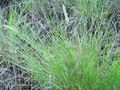
photo by Craig Althen, 2010.
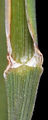
Sheathing leaf, photo by Robert L. Carr, 2013
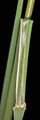
Photo Robert L. Carr, 2013
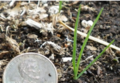
Seedling, courtesy of CNLM
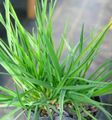
Courtesy of CNLM


References
- ↑ Integrated Taxonomic Information System. Retrieved from https://www.itis.gov/servlet/SingleRpt/SingleRpt?search_topic=TSN&search_value=503284
- ↑ 2.0 2.1 2.2 Ogle, Daniel G. 2012. Plant fact sheet for prairie junegrass (Koeleria macrantha). USDA-Natural Resources Conservation Service, Boise, ID
- ↑ 3.0 3.1 Bowcutt, F., & Hamman, Sarah. (2016). Vascular plants of the South Sound prairies (First ed.). Olympia, Washington: The Evergreen State College Press.
- ↑ Hitchcock, C. L., Cronquist, A., Giblin, D., & Legler, B. et al. (2018). Flora of the Pacific Northwest: an illustrated manual. Seattle: University of Washington Press.
- ↑ Simonin, Kevin. 2000. Koeleria macrantha. In: Fire Effects Information System, [Online]. U.S. Department of Agriculture, Forest Service, Rocky Mountain Research Station, Fire Sciences Laboratory (Producer). Available: https://www.fs.fed.us /database/feis/plants/graminoid/junroe/all.html [2020, June 9].
